Keiko’s suicide
A Pale View of HillsKeiko’s suicide in Manchester is a death shaped by isolation before it occurs and by a memory that continues to trouble her family afterward. The delayed discovery, the narrow terms in which newspapers report her death, and Etsuko’s repeated recollection of it make the event more than a single moment of loss: it exposes how little of Keiko’s life was visible even to those living with her.
Background and Withdrawal
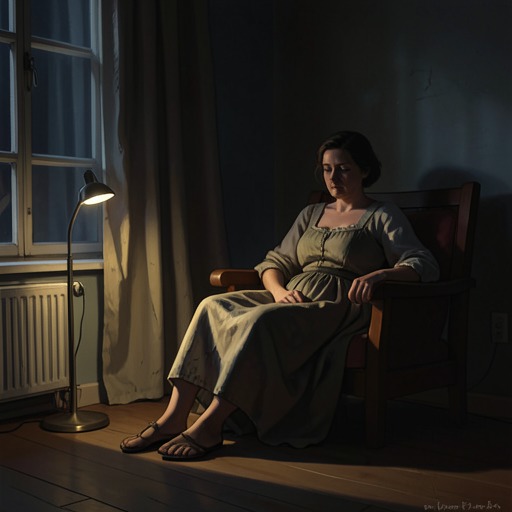
For two or three years before her death, Keiko increasingly withdrew into her bedroom and shut her family out. She rarely came downstairs, had no friends, and did not allow the rest of the household into her room. At mealtimes, Etsuko left her a plate in the kitchen; Keiko came down to collect it and then returned to her room. The family’s contact narrowed to brief, practical exchanges, including a routine in which Etsuko washed and returned a bag of Keiko’s laundry every few weeks.
Keiko’s rare appearances in the living room did not restore ordinary family closeness. They commonly ended in arguments with Niki or Etsuko’s husband, after which Keiko went back to her room. The household gradually adjusted to her absence, making the separation seem like an established arrangement rather than a crisis. In retrospect, that pattern gives the eventual discovery of her death a painful continuity with the days when she had already been present in the family home without being seen.
Death and Discovery
Keiko died by suicide in her room in Manchester. Etsuko’s first thought on hearing the news was to wonder how long Keiko had been there before anyone found her. The coroner later said that she had been dead for several days. Her landlady opened the door because she believed Keiko had left without paying the rent; it was not a family member or friend who discovered her.
The circumstances sharpen the contrast between Keiko’s isolation at home and her vulnerability in a city where no one knew her. Even within her family, she had spent years largely behind a closed door. In Manchester, her absence went unnoticed for days. The delayed discovery is therefore not an incidental detail in Etsuko’s recollection: it gives concrete measure to the distance surrounding Keiko’s final life.
Public Reporting and Private Grief
Newspapers in England emphasized that Keiko was Japanese and treated that fact as if it explained her suicide. Etsuko objects to the racial assumption beneath this reporting: the press invoked a supposed Japanese disposition toward suicide instead of seeking further explanation. In the public account, Keiko’s nationality displaced the particular circumstances of her life and death.
Within the family, the subject was seldom discussed at length, but it remained present in the silences around conversation. Niki recalls having found Keiko miserable to live with, while also remembering that she was sad when she heard of her death. Her response holds resentment and grief together without resolving either. The death thus remains part of the sisters’ family history even when they do not dwell on it.
Etsuko’s Recollection
Etsuko repeatedly returns to the knowledge that Keiko had been alone in her room for days. She says that the image’s horror has not diminished, though her relation to it has changed: it has become familiar through repetition, like a lasting wound. This is not relief or closure. It is the uneasy persistence of a disturbing memory that has become woven into her inner life.
The novel frames this recollection through a later exchange with Niki. Asked what she is thinking about, Etsuko turns toward the memory of a woman she once knew. The movement from present conversation into remembered loss shows how Keiko’s death continues to surface indirectly. Its importance lies not only in the fact of her suicide, but also in the family’s preceding estrangement, the failure to discover her quickly, and the long afterlife of the event in Etsuko’s memory.